
It is reassuring when a company has a lot of cash in the bank. But what if it also has a lot of debt to repay in the near future? Rather than looking only at how much cash there is, look also at when it came in and what it will have to be used for.
Cash is an important resource: it can cover unexpected spending or be invested in the business. But a large number on the balance sheet does not, by itself, mean the company can spend that money freely.
Cash and cash equivalents
A balance sheet usually shows cash and cash equivalents together. Cash equivalents are short-term financial instruments that can easily be turned into a known amount of cash and carry very little risk of changing in value. To see exactly what is classified there, check the terms of the instruments and the company's accounting policies.
Other short-term investments are sometimes shown as a separate line item. Before you add them to cash as if they were the same thing, check when they can be turned into cash and whether their market price can change. Something labeled "short-term" cannot always be sold right away without a loss.
Some cash may also be tied up, for example as collateral for a particular contract, so that its use is restricted. Alico, a real U.S. company, is one case: in its filings it separately described cash whose use was restricted to secure a particular contract. The reasons for such restrictions, and when the cash becomes available, differ from company to company.
Looking at cash and debt side by side
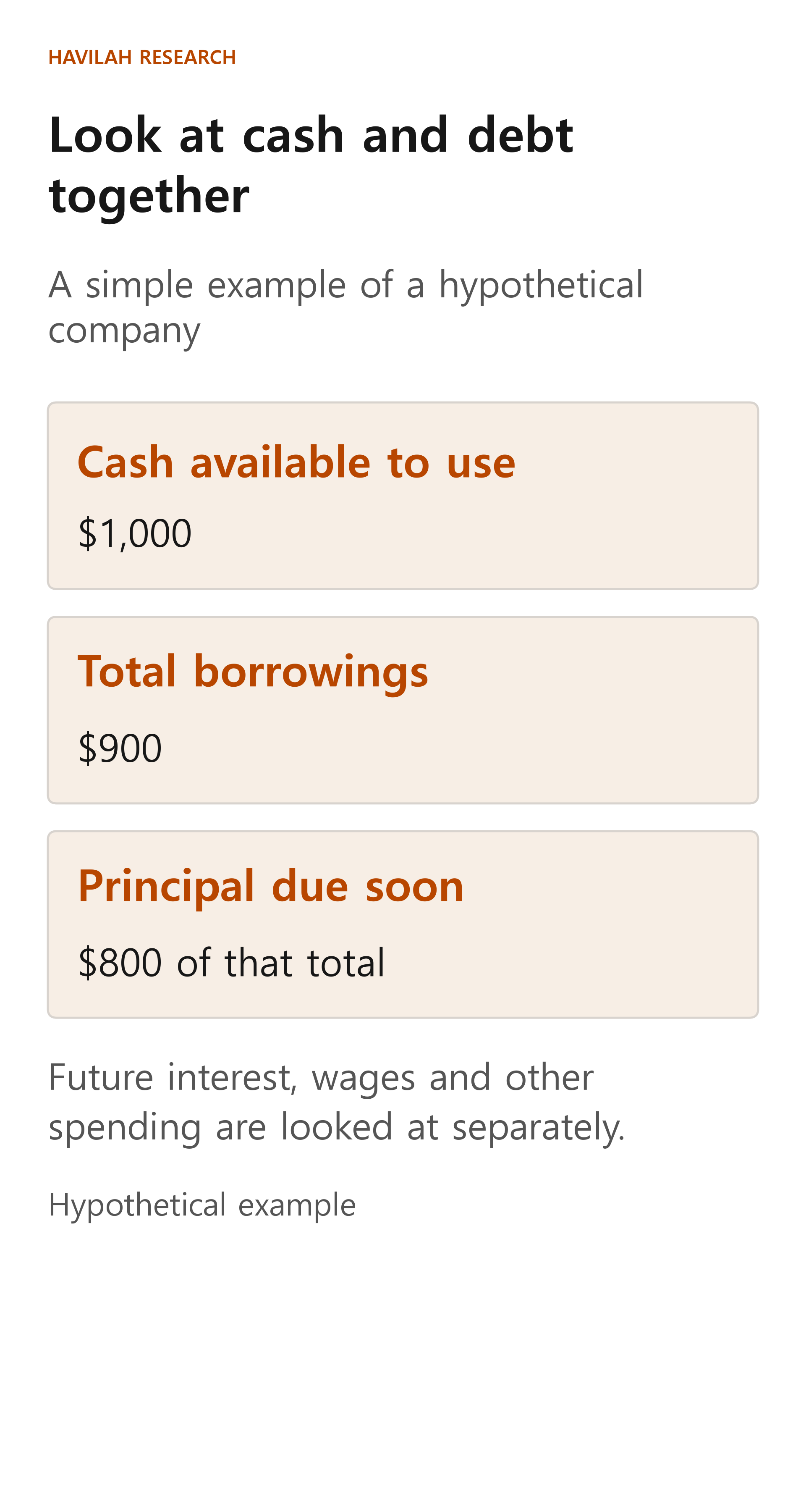
Suppose a hypothetical company has, on a given date, $1,000 of cash it can use freely and $900 of borrowings. Simply subtracting the borrowings from the cash leaves $100. This is a simple comparison that leaves out any other financial instruments or liabilities.
| Hypothetical item | Amount |
|---|---|
| Cash available to use | $1,000 |
| Total borrowings | $900 |
| Cash minus borrowings | $100 |
This $100 does not tell you how much money the company can actually spend freely. It ignores money the company will need, such as employee wages, materials, taxes and investment in equipment and facilities. The company may also have liabilities other than borrowings.
When does the debt have to be repaid?
Now suppose that $800 of the hypothetical company's $900 of borrowings must be repaid in the near future. If the company repays only that $800 of principal in cash, with no other cash coming in or going out, it is left with $200 of cash and $100 of borrowings.
The simple difference between cash and the remaining borrowings is still $100. But the cash actually on hand has shrunk. If the company then has to pay wages or interest, the room it really has changes further. This is why, even when the difference is the same, you need to look at when the debt is repaid and what spending lies ahead.
On the other hand, if most of the borrowings are not due for a long time and cash comes in steadily from the business, the company may have more time to respond. Even so, future cash inflows are not guaranteed. It is worth checking which liabilities fall due soon, the schedule of interest payments and whether the company will need to borrow again.
Where did the money come from?
If cash has increased, look for the reason in the cash flow statement. The cash flow statement splits cash flows into operating, investing and financing activities. The increase means different things depending on whether cash came in from selling products, from new borrowing or from issuing shares. When a company borrows, its cash rises, but so does its obligation to repay.
Likewise, a fall in cash is not necessarily a bad sign. The money may have gone to repay debt or to buy equipment the business needs. Check what the money was spent on and how the business performs afterward.
Questions to ask as an investor
First, check what the cash and short-term investments consist of and whether any of them are restricted. Then look, in turn, at the total amount of borrowings and when they are due, the operating costs and capital spending the business will need, and the cash coming in from the business. If the money sits in foreign subsidiaries, it also matters which company holds it and whether there are limits on using it.
The cash on a balance sheet is the balance on a specific date. If you go on to read the obligations and cash flows behind that number, you will better understand how flexibly the company can use its money.