
Two companies made the same profit. One has plenty of cash, while the other has a lot of debt it must repay soon. Judged by profit alone, the two companies may look alike, but their financial staying power can differ.
The document to look at here is the balance sheet. A balance sheet sets out, as of a specific date, the assets a company has, the obligations it must pay or fulfill, and its shareholders' equity.
What are assets, liabilities and shareholders' equity?
Assets are resources a company uses in its business or that can bring it economic benefits in the future. Examples are cash, money customers owe the company, inventory waiting to be sold and the machines the company uses. Some assets, such as patents, cannot be touched.
Liabilities are obligations the company must pay or fulfill. They can include not only money borrowed from a bank but also money the company will pay its suppliers later. As you learned earlier, an obligation to provide a service the company has already been paid for, but has not yet delivered, can also be a liability.
In accounting terms, shareholders' equity is what remains after subtracting liabilities from assets. It is made up of items such as the money invested in the company and the profits it has kept from its business. Equity here is not the same number as the price at which the company is valued in the stock market. The amount the company would actually receive if it sold its assets can also differ from the amount recorded in its books.
The three items are linked by the following relationship.
Assets = Liabilities + Shareholders' equity
Working through a hypothetical company
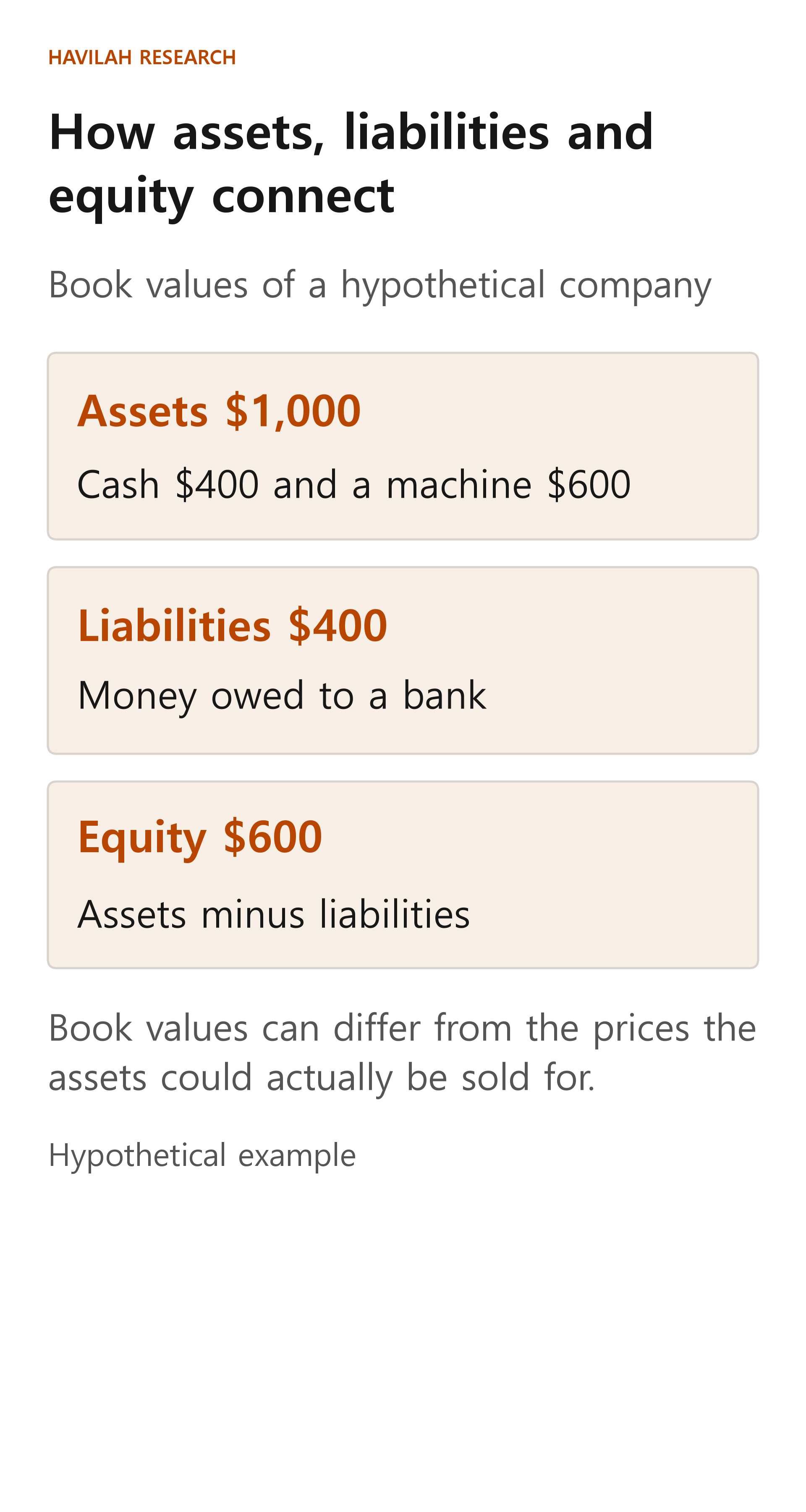
Suppose that on a given date a company holds $400 in cash and a machine recorded in its books at $600. It has no other assets, so its total assets are $1,000. This does not mean the machine could be sold for $600 right away.
Assume the company owes a bank $400 and has no other liabilities. Subtracting $400 of liabilities from $1,000 of assets leaves $600 of shareholders' equity in accounting terms.
| Item | Hypothetical book value |
|---|---|
| Cash | $400 |
| Machine | $600 |
| Total assets | $1,000 |
| Liabilities | $400 |
| Shareholders' equity | $600 |
Total assets of $1,000 equal the sum of $400 of liabilities and $600 of shareholders' equity. This relationship lets you look at a company's assets together with the liabilities and equity that stand against them.
What happens if the company borrows more?
Suppose the company borrows another $100 from the bank and receives it in cash. There are no other transactions or costs, and it has not spent the money yet.
Cash rises from $400 to $500, so total assets become $1,100. At the same time, the debt owed to the bank also rises from $400 to $500. After this simple transaction, shareholders' equity stays at $600.
This is why you cannot conclude that a company made a profit just because its assets grew. Look at what increased the assets, and look at the liabilities alongside them. Borrowed money has to be repaid later, and depending on the loan agreement, the company may also have to pay interest.
Where do you look in a real company?
The balance sheet in the annual report of Target, the U.S. retailer, shows total assets, liabilities and the equity belonging to shareholders as separate items. The real statement has many more line items than this hypothetical case, so start by finding the items you are interested in, such as cash, inventory and borrowings.
Even if a company seems to have a lot of cash, it may have less room than you think if it has large debts due soon. On the other hand, having debt does not automatically make a company risky. Also check when the debt is due, whether cash is coming in from the business and whether the company can afford the interest.
What the numbers do not show
A balance sheet is a record of a specific date. If the company borrows a large sum or buys assets the next day, the picture can change. So compare it with the balance sheets of earlier periods, and look at the income statement and the cash flow statement as well.
Also, shareholders' equity of $600 does not mean that $600 will necessarily be left if the company is sold. Book values and actual sale prices can differ, and the value of the business in the future cannot be settled by a single figure in the books. The balance sheet is a starting point for examining what a company owns and what it owes.