
A company announces that it will acquire another company. The company says it will gain new technology and new customers, so it sounds as if the business will get better.
But the acquired company may not earn as much as expected, or combining the two may cost more than planned. What the company pays, and what risks come with the deal, matter as much as what it gets.
What does a company get when it buys another?
An acquisition is the purchase of another company's shares or business in order to gain control of the company or the business. The aim may be to gain products, technology or customers the company did not have before, or to expand into other regions.
When the acquired business and the existing business working together produce a bigger effect than each would on its own, this is called synergy. For example, the expectation that the acquired company's products can be introduced to more customers through the existing sales network is a hoped-for synergy.
But an expectation is not yet a result. If customers do not buy the products, or if it takes time for new employees to settle into the existing organization, the effect may be smaller than expected.
Compare the price paid with the cash still to come in
Suppose a hypothetical company spent $400 in cash to buy another company. At the time of the deal, management expected the acquired business to bring in $100 of cash a year for the next 5 years, after subtracting the costs it needs.
Expected cash over 5 years: $100 a year × 5 years = $500.
Now assume that, because customers left and extra costs arose, it actually brought in only $70 a year over those 5 years.
Actual cash over 5 years: $70 a year × 5 years = $350.
On a simple total, that is $150 less than expected and $50 less than the $400 spent on the acquisition. This alone does not settle the final gain or loss on the whole acquisition, because the business may still bring in cash after 5 years, and the amount the company could get by selling the business may also change. These numbers are a hypothetical example for illustration.
Also, money received in the future arrives at a different time from money in hand today. When you assess the real value, you need to consider when the cash comes in and the risks involved. The calculation above is a simple comparison that does not reflect those differences.
Unexpected things can happen after an acquisition
Combining a new company with the existing organization can bring costs for staff training, changes to IT systems and sorting out contracts. If key employees or customers leave, the expected revenue may not materialize. If the company borrowed to fund the acquisition, it also takes on interest and principal repayments.
Teradyne, a maker of semiconductor test equipment, explains in its annual report that integrating acquired businesses can be complex, costly and time-consuming, and that it may not achieve the synergies and cost savings it expected. This disclosure points out a possible risk; it is not a judgment that any particular acquisition has failed.
What is goodwill?
When a company is acquired, the assets obtained and the liabilities taken on are valued separately. In a simple acquisition, if the price paid is greater than the fair value of the identifiable assets minus the liabilities, that excess, among other amounts, may be recorded as goodwill. Fair value is an amount assessed on the basis of the price at which an asset or liability would trade in the market. Goodwill can reflect, among other things, the benefits the company expects from combining the acquired organization with its existing business.
If the expected business results worsen, an impairment loss may arise that lowers the accounting value of goodwill. An impairment loss reduces the value recorded on the books and is recognized as an expense. An impairment loss does not mean that the same amount of cash leaves the company at that time. Use it as a clue for comparing the expectations at the time of the acquisition with the results that followed.
What should investors check?
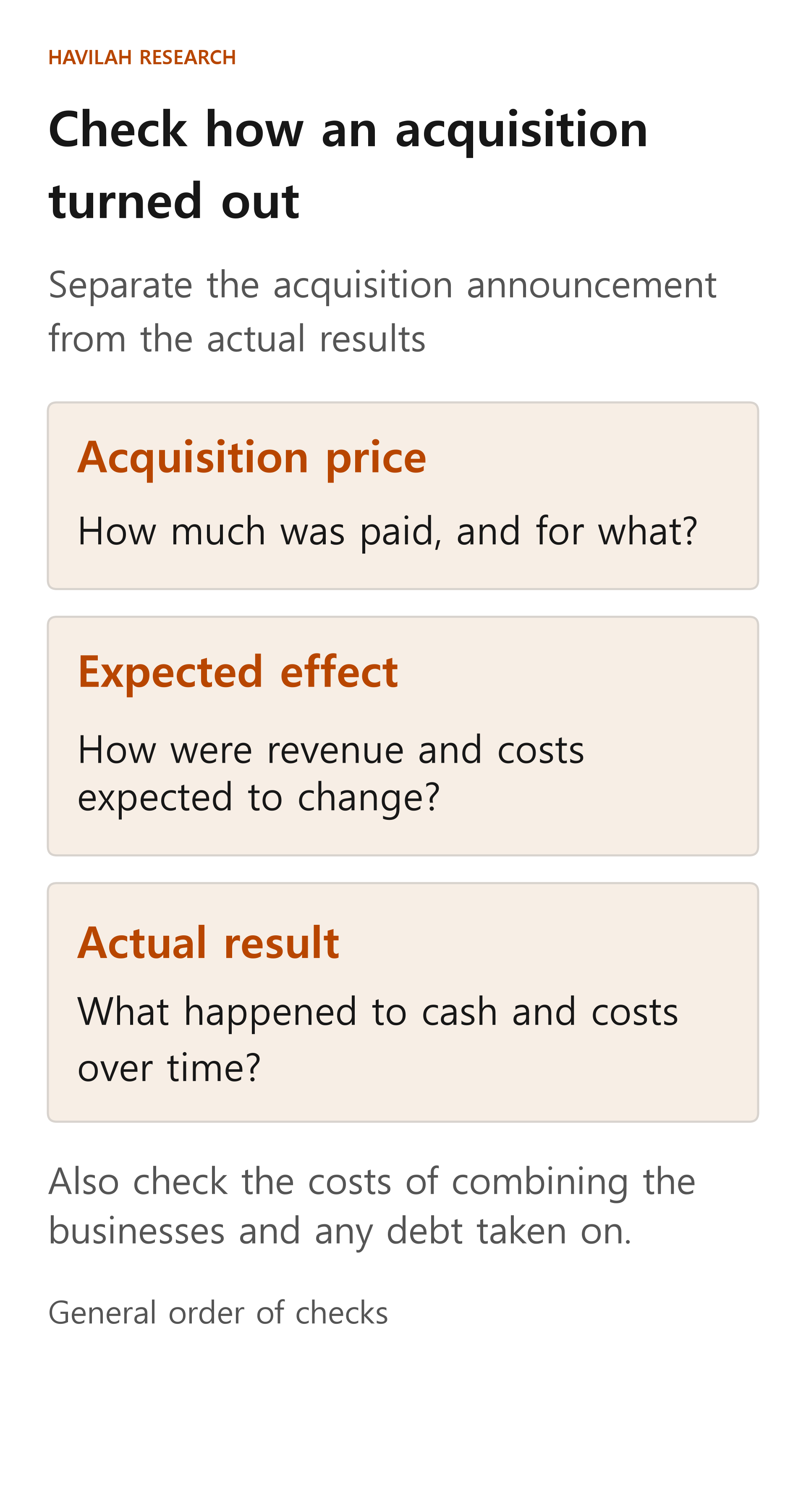
Start with the purpose of the acquisition and the price paid. Next, check whether the company used cash or took on debt, and what revenue growth or cost savings it expects.
After the deal is done, compare over several periods whether the expectations are showing up in actual revenue, profit and cash flow. If the expected synergies differ from the actual results, also check what changed. It is important not to judge success by the size of the acquisition announcement alone.