
When a company buys back its own shares, the remaining shareholders' ownership percentages can rise. Does that mean a buyback is always a good thing?
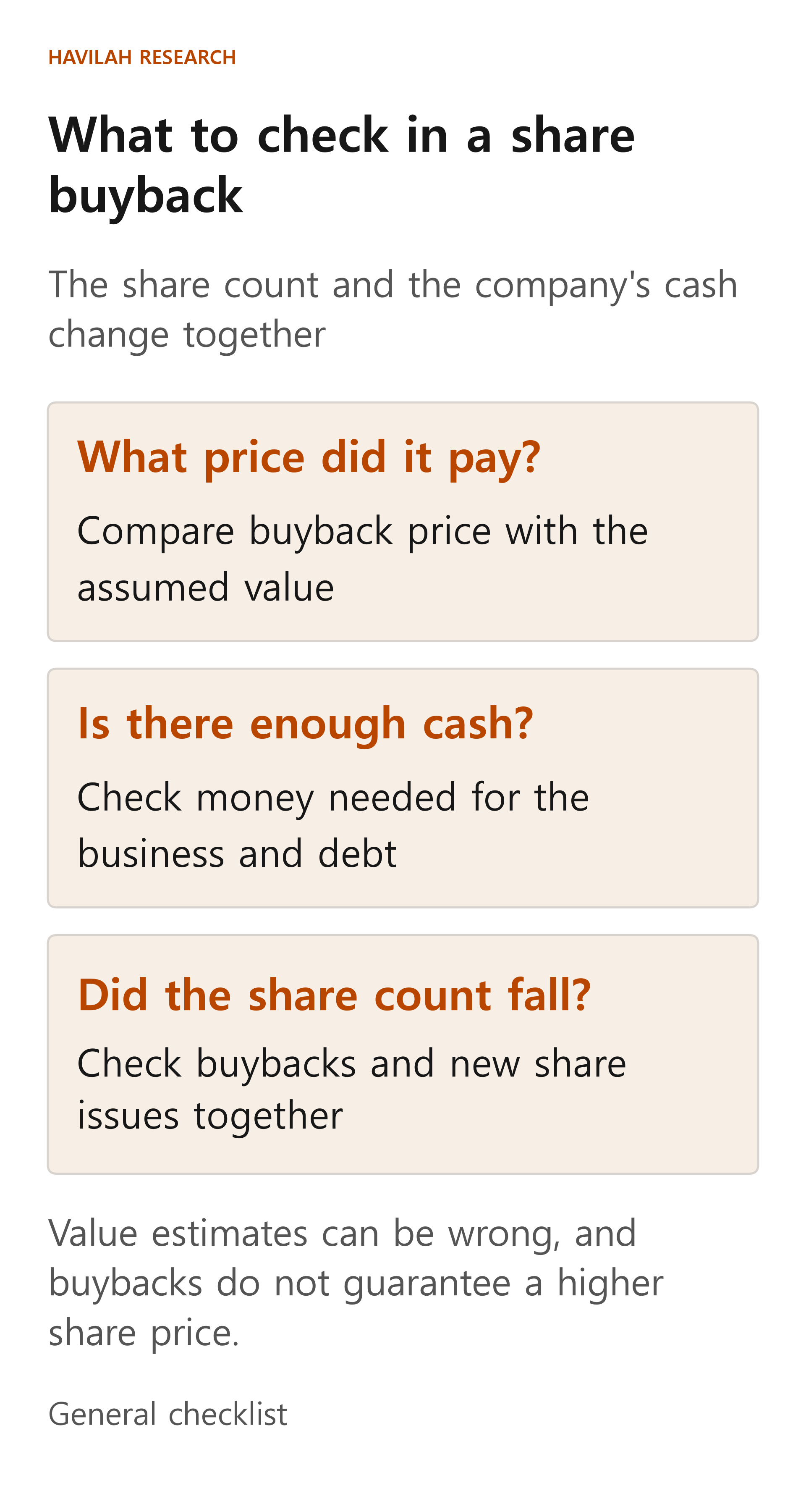
Not necessarily. The company spends cash to buy the shares, so it matters what price it pays and whether that money is needed elsewhere.
Assume a value for one share
Suppose a hypothetical company has 100 shares, and the shareholders' portion of the whole company, including its cash, is valued at $1,000. The company has enough cash for the buyback and does not borrow to fund it. Assume also that there are no other classes of shares and no new shares to be issued.
Assumed value of the whole company $1,000 ÷ 100 shares = assumed value of one share $10.
This $10 is an estimated value for the calculation. It is not an actual share price or a precisely measured value. In reality, no one knows the company's future results, so different people can value it differently.
What happens if the company buys below $10?
Assume the company pays $8 a share to buy back 10 shares and removes them from the shares outstanding. To keep it simple, there are no fees or taxes, and the company's value does not change except for the cash spent on the buyback.
The company pays $8 × 10 shares = $80. The assumed company value falls from $1,000 to $920 as the $80 of cash goes out, and 90 shares remain.
Remaining value $920 ÷ 90 remaining shares = about $10.22 per share.
This is higher than the $10 per share assumed at the start, because the company paid less than the assumed value of one share to buy the shares back. The amount is rounded to two decimal places.
Pay more, and the result changes
Now assume the same company buys back 10 shares at $12 each. The company pays $120, and the remaining company value is $880. The same 90 shares remain.
Remaining value $880 ÷ 90 remaining shares = about $9.78 per share.
This time the result is lower than the $10 assumed at the start. The share count fell by the same amount, but the company paid out more cash. This is also a hypothetical calculation rounded to two decimal places.
Both examples assume that the company's value before the buyback is known to be exactly $1,000. In reality, you cannot know this value precisely, and both the buyback price and the company's business outlook keep changing. The results are not a prediction that the actual share price will become $10.22 or $9.78.
A company should not spend the money it needs
Even if a company buys its shares at a price it considers fair, it can be risky if it cuts too deeply into the cash it needs to run the business or repay debt. Robinhood explains in its annual report that buybacks reduce the cash available for running the business and for capital investment, among other uses, and do not guarantee an increase in shareholder value.
If a company borrows to buy back shares, you also need to check the burden of interest and principal repayments. On the other hand, if the business has few good investment opportunities and the company has plenty of spare cash, a buyback can be one way to return money to shareholders.
What should investors check?
First, separate the announced plan from the number of shares and the amount actually bought back. After announcing a plan, a company may buy back only part of it or not carry it out at all. And if new shares were added at the same time, for example through employee compensation, the total number of shares outstanding may not fall by as much as the buyback.
Next, look at the cash spent on buybacks together with the cash remaining, the company's debt and its planned capital investment. To judge whether the buyback price was reasonable, you also need an assumption about the company's value. Your judgment should include the possibility that this assumption is wrong.