
You hear that a company you have invested in has signed a big contract or replaced its chief executive officer. From the headline alone, it is hard to tell whether the contract has already taken effect or when the management change happens.
When you want to check an important event at a U.S. company, the 8-K can be your starting point. The 8-K is a report a company uses to announce major events without waiting for its regular annual or quarterly report.
What kinds of events does it report?
An 8-K can cover many kinds of matters, such as important contracts, acquisitions of other companies, fundraising, changes in key executives and earnings announcements. This does not mean that every contract or every personnel change must be filed on an 8-K. You need to check this against the nature of the event and the disclosure requirements.
Each report carries section numbers called Items. The numbers help you see what kind of event the company is reporting. For example, you can find an important contract under Item 1.01, an earnings announcement under Item 2.02 and changes to certain officers or directors under Item 5.02.
What the number tells you is the type of event. Whether it is good news for investors, and whether the matter has already been completed, you can only learn by reading the text.
Read the main text and the attachments of a real 8-K together
As an example, take the 8-K that Apple filed on July 30, 2026. The report's detail listing shows Item 2.02 and Item 9.01, and its attached documents include EX-99.1.
In this example, the attachment is Apple's earnings release for fiscal Q3 2026. The revenue figures and the explanation about tariff refunds that we looked at in the previous lesson are in it. The main text of an 8-K can be short and may point to an attachment, so do not close the document after reading only the main text; look for the related attachments in the listing as well.
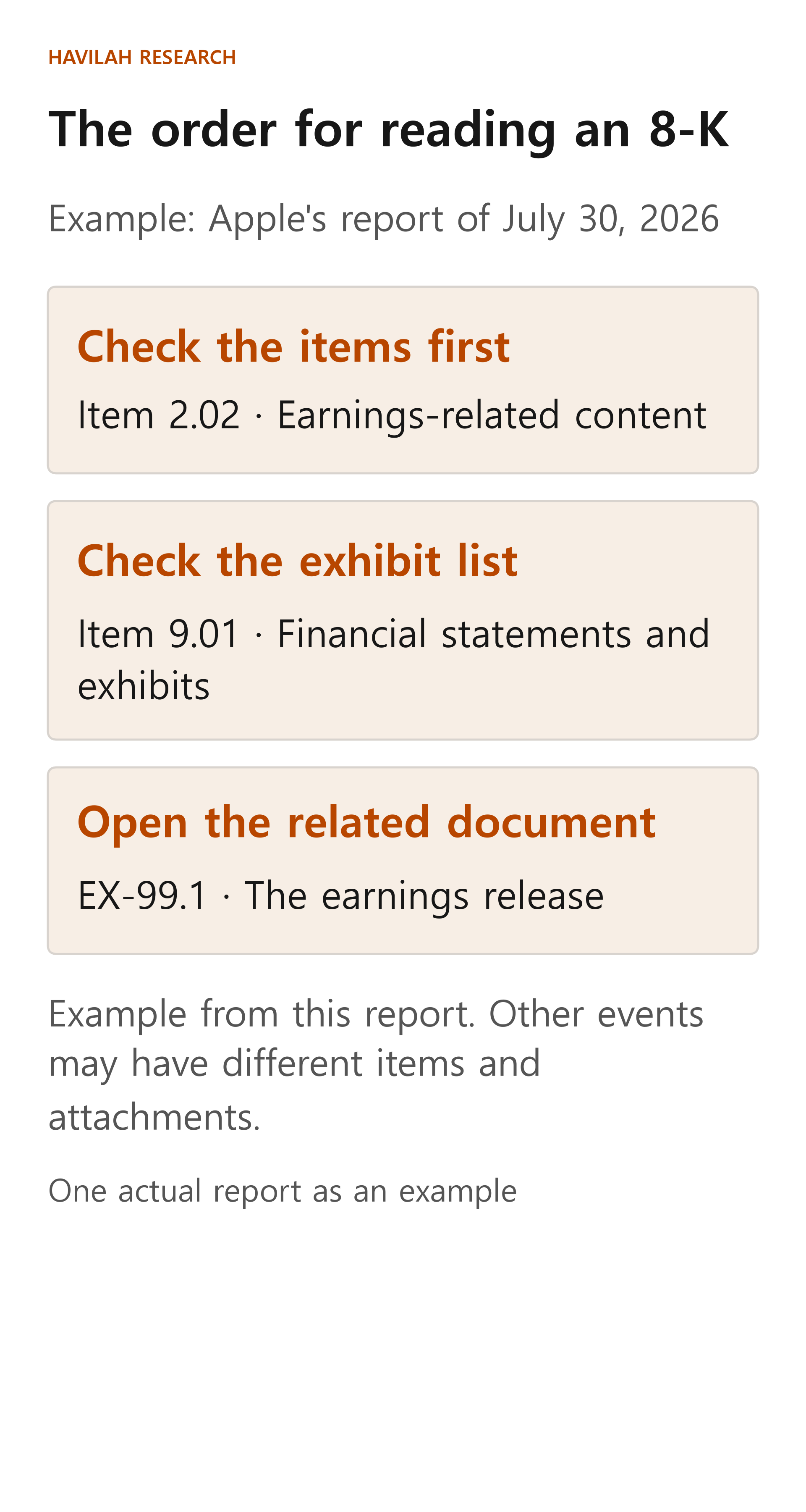
This example is a single report filed at a particular time. It does not mean that every 8-K comes with an earnings release or that the attachment numbers are always the same.
For agreements, tell the announcement apart from completion
Suppose a hypothetical company has agreed to acquire another company. The fact that an agreement has been signed is different from the fact that the acquisition has been completed. If conditions still remain, the deal may change or may not be completed.
In the report or the related attachments, check what is being bought, how much is being paid, whether the money comes from cash or borrowing, and what conditions must be met to complete the deal. If an article gives only the purchase price, the timing of payment and any additional costs become questions to look into.
Checking only the new executive's name is not enough either. Look at when the person actually takes office or steps down, and whether the company explains the reason for the change. Whether a change of management is good or bad in itself can only be judged after you check more of the background.
What happens to existing ownership when new shares are issued?
A company may issue new shares to raise money. In that case, even if existing shareholders keep the same number of shares, their ownership percentage falls as the total number of shares rises. This is called dilution.
Suppose a hypothetical company has 1,000,000 shares of a single class, and you own 10,000 of them. Your percentage is 10,000 shares ÷ 1,000,000 shares, or 1%.
If the company issues 200,000 more shares of the same class and your holding does not change, the total becomes 1,200,000 shares. Your percentage is then 10,000 shares ÷ 1,200,000 shares, or about 0.83%. This assumes there are no other share issues and no changes in the company's own repurchased shares (treasury shares).
A lower percentage alone does not necessarily mean your investment has become worse. You also need to check what new money comes into the company and what it will be used for, and what the issue price and terms are. How the value per share changes cannot be decided from the ownership percentage alone.
What should you check after reading a filing?
First, work out whether the event is an announcement or a completion, and write down the dates, the amounts and the conditions that apply. If the terms have not been settled yet, do not fill them in with guesses; mark them as unconfirmed.
Next, check whether a contract or presentation is attached, and look at later reports to see whether the deal was actually completed. An event can bring both benefits and risks. Rather than trading as soon as a filing appears, first understand what changes it brings to the company's business and finances.