
Yesterday you had 10 shares; today you have 20. But the price of each share has been cut in half. Did you make money or lose it?
In your account, not only the share price but also the number of shares and whether you can trade can change. If you look at only one number, you can badly misread what happened. You need to look at what changed and why it changed.
1. Your shares can double while your money stays the same
A stock split divides each existing share into several shares. It helps to think of cutting one big piece, the company, into smaller pieces. The number of pieces goes up, but the company's factories and cash do not grow by themselves.
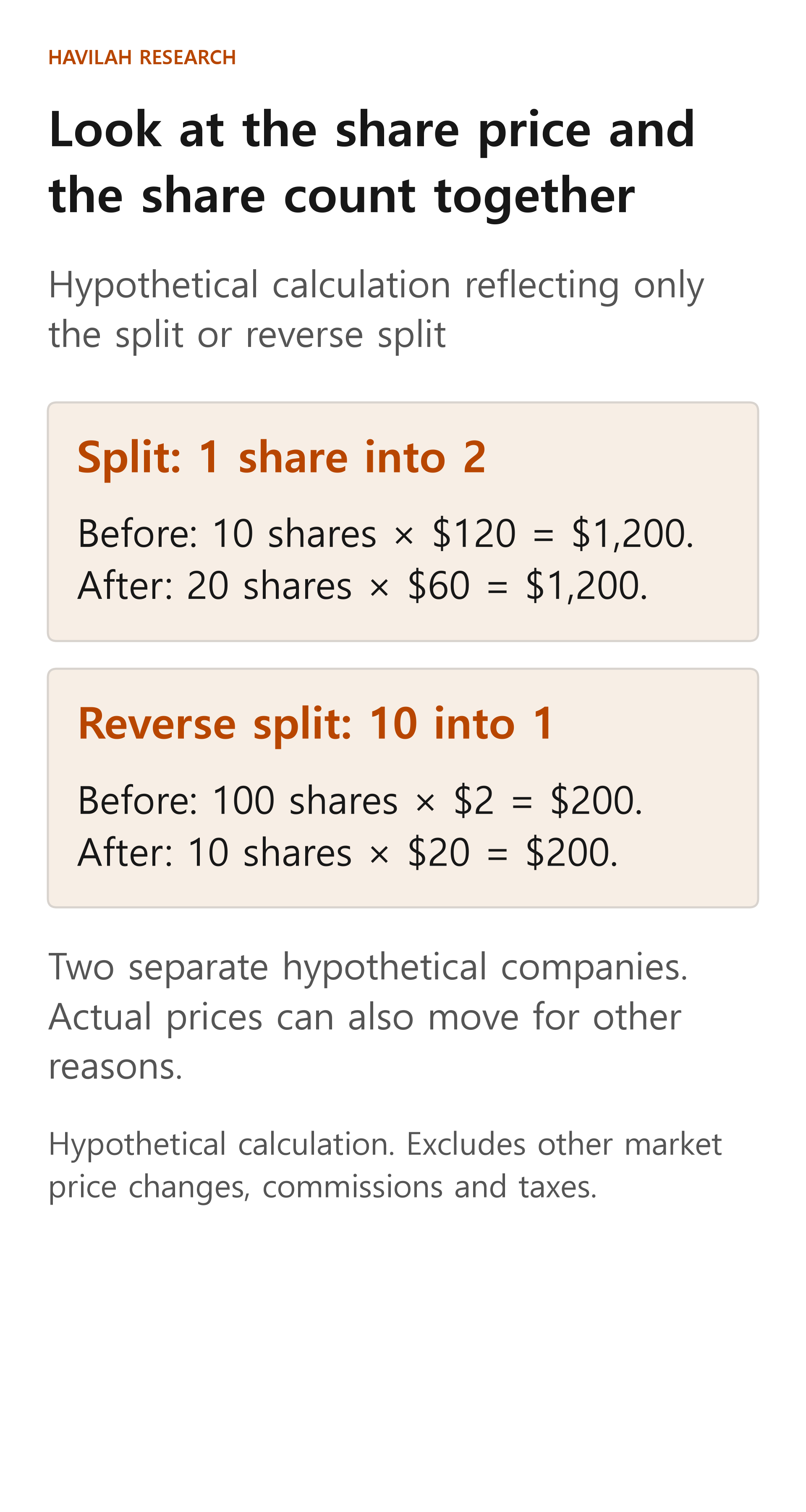
Suppose you own 10 shares of a hypothetical company, and the price per share is $120. If the company splits each existing share into two, you will hold 20 shares.
Assuming there are no other price changes and only the split is reflected, the price per share is adjusted to $60.
| Item | Before the split | After reflecting only the split |
|---|---|---|
| Shares held | 10 shares | 10 × 2 = 20 shares |
| Price per share | $120 | 120 ÷ 2 = $60 |
| Value of your shares | 10 × 120 = $1,200 | 20 × 60 = $1,200 |
The number of shares multiplied by the price per share gives the same result. Receiving twice as many shares does not mean your investment has doubled. Conversely, the price per share halving does not mean you have lost half your money.
Your ownership stake in the company also stays the same. If the company has 1,000 shares in total, your 10 shares make up 10 ÷ 1,000 × 100 = 1%. After the split, there are 2,000 shares in total and you have 20, so your stake is 20 ÷ 2,000 × 100 = 1%.
This calculation explains the effect of the split itself. Once trading gets going, the share price moves again with the news and with buy and sell orders. It does not mean that the price will stay at exactly $60 after the split.
2. Combining several shares into one does not make you richer
It can also go the other way. Combining several shares into one is called a share consolidation. In U.S. materials, it is also called a reverse stock split, or simply a reverse split.
This time, take a different hypothetical stock. You hold 100 shares priced at $2 each, and the company combines every 10 existing shares into one new share.
Shares held = 100 shares ÷ 10 = 10 shares
Price per share after reflecting only the reverse split = $2 × 10 = $20
Value before the reverse split = 100 shares × $2 = $200
Value after the reverse split = 10 shares × $20 = $200
The price per share has risen tenfold, but the number of shares has fallen to 1/10 of what it was. The value of your shares is unchanged. Both examples leave out commissions, taxes and any separate changes in the market price.
A company whose share price has fallen very low sometimes carries out a reverse split to meet an exchange's continued listing standards. Continued listing standards are the requirements a company must meet to keep trading on that exchange.
That does not mean every reverse split happens for the same reason, or that the share price always falls afterward. But combining shares does not, on its own, turn a loss into a profit or reduce debt. Rather than focusing on the higher price per share, read why the company did it and whether its situation has changed.
Your holding may not divide neatly by the reverse split ratio. In that case, check the company's terms and your broker's guidance to see how the leftover fractional shares are handled. They may be settled in cash, so do not assume that the fractional shares will simply stay in your account.
3. The day of the announcement and the day your account changes can differ
When you hear about a split, check the schedule as well as the ratio. The day it is announced, the day the shares are distributed and the day trading starts at the adjusted quantity and price may not be the same.
As a real example, NVIDIA announced in 2024 a split that divided each existing share into ten. Its announcement said that the additional shares would be distributed after the market closed on June 7, and that trading on a split-adjusted basis would start when the market opened on June 10. It also explained that the process of reflecting the split in accounts held through brokers could differ.
The point here is not to memorize dates. It is that seeing a "split announcement" does not mean that the number of shares in your account increases at that moment.
If the quantity and the displayed price in your account differ from what you expected, first compare the company's announcement with your broker's processing notice. If you multiply a quantity taken at one point in time by a price taken at another, you can miscalculate the value of your shares.
Do not jump to the conclusion that it is just a processing delay, either. If there is a difference that the effective date and the ratio in the notice do not explain, check with your broker. There is no need to rush an order just because the screen looks unfamiliar.
4. A trading halt stops the trading, not the share price
A trading halt is a measure that temporarily suspends trading in a particular stock. For example, an exchange may halt trading while important company news is being released to the market. The SEC, the U.S. securities regulator, can also suspend trading to protect investors. The procedure depends on who stopped trading and why.
Even if the last traded price is still shown on the screen, that does not mean you can sell at that price right away. You can see a price, but trading itself may be restricted.
For example, suppose trading was halted ahead of an important announcement. When trading reopens, investors place new orders that reflect what was announced. Depending on whether the news is good or bad, the stock may trade at a different price from before. The price before the halt is not guaranteed once trading resumes.
Do not take the words "trading halt" on their own to mean bankruptcy. At the same time, do not assume that once a halt ends you can always trade as usual. Check the reason for the halt, the conditions for resuming and whether any other restrictions remain, in official notices and in your broker's guidance.
Nor can you conclude, just because the order button in your app is disabled, that the stock has been halted for the whole market. It may be a matter of your broker's support or processing. Check actions by the company, the exchange or the regulator separately from your broker's service.
5. Delisting means being removed from the exchange
Delisting means that a stock listed on a particular exchange is removed from that exchange's list. It can happen because the company failed to meet the exchange's standards, or for reasons such as a merger or acquisition. A merger or acquisition is when a company is bought by another company, or when companies combine. What shareholders are left with depends on the reason.
Being delisted does not, by itself, mean that the shares instantly disappear or that your investment is automatically refunded. After delisting, the company's shares may still exist and may trade over the counter. The over-the-counter market is where shares trade outside the major exchanges discussed here. In U.S. materials, it appears under the name OTC.
However, "the shares still exist" and "you can sell them when you want" are different things. Your broker may not support trading in that market, and there may be few buyers or little public information. There is also no guarantee that trading will carry on in another market.
If the company has entered bankruptcy proceedings, the problem is bigger. Common shareholders come after creditors, who are owed money by the company. Even if the company keeps operating, the existing common stock may be canceled or become worthless. The company surviving is not the same as your old shares surviving.
On the other hand, if a stock is delisted because of a merger or acquisition, your shares may, for example, be exchanged for an agreed amount of cash or for shares of another company. Even then, you need to read the actual terms of the deal. That is why, instead of stopping at the single word "delisting," you need to check the reason and how your shares will be treated.
6. When your account changes, look at three things together
First, look at the number of shares and the price per share together. For a split or a reverse split, compare the total value after applying the ratio. Do not judge your return from the price per share alone.
Next, check whether the stock can be traded. Even if a quantity and a market value appear in your account, whether you can actually sell may be a different matter. Check separately for a trading halt, a delisting and the limits of what your broker supports.
Finally, read how the event changes what shareholders get. See whether you keep the same proportion of shares, whether your shares are converted into cash or other shares, and whether there is a risk that the existing shares will be canceled.
| What happened | What to check first |
|---|---|
| Stock split or reverse split | Ratio, effective date, adjusted quantity and price, handling of fractional shares |
| Trading halt | Who halted trading and why, conditions for resuming, remaining restrictions |
| Delisting | Reason for the delisting, treatment of your shares, possible ways to trade |
A split changes the number of pieces your stake is cut into, a trading halt stops trading, and a delisting changes the stock's status on the exchange. Only when you can tell apart what each one changes can you read your real gains and losses correctly.
You have now looked at the basic structure of how U.S. stocks are traded. In the next lesson, we will look at which brokerage account to choose to enter this market.