
Overnight, you see news that a stock you are watching has risen 10%. You open your app, and the regular session has not started yet. If you buy now, are you seizing the opportunity before everyone else?
The first thing to check is when that price was set and in what kind of trading. Even for the same company's shares, the orders taking part and the conditions for filling them can differ depending on when you trade.
1. The same stock has different trading sessions
The regular session for U.S. stocks usually runs from 9:30 a.m. to 4 p.m. Eastern Time. Trading before it is called pre-market trading, and trading after it is called after-hours trading. All trading outside the regular session is called extended-hours trading.
| Session | Relation to the regular session | What to look at first |
|---|---|---|
| Pre-market | Before the regular session opens | Overnight news, current quotes and volume |
| Regular session | Standard trading hours | Current quotes, order quantity, fill conditions |
| After-hours | After the regular session closes | Announcements after the close, current quotes and volume |
Some brokers also offer separate overnight trading after the after-hours session. But this does not mean that every U.S. stock can now be traded at any time. Check which stocks, hours and order types are available by looking at your own broker's service.
Extended-hours trading is not simply the regular session's clock stretched out. The trading systems used and the orders connected to them can be different, and order types that were available during the regular session may not be supported outside it.
2. When trading is thin, the gap between prices can widen
Volume is the number of shares actually traded over a period of time. The quantity shown in a quote is the quantity of orders that have not been traded yet. Keep the quantity already traded separate from the quantity that could still be traded.
Outside the regular session, there may be fewer orders looking to trade than during it. If there are not enough orders on the other side near the price you want, your order may not trade at all, or only part of it may be filled. This situation is described as low liquidity.
The bid is the price at which others are willing to buy, and the ask is the price at which others are willing to sell. The spread, which is the gap between these two prices, can also widen outside the regular session. Of course, this does not always happen for every stock. Trading can pile into a stock with important news even outside regular hours, and some stocks trade thinly even during the regular session.
Let's look at a hypothetical stock. Yesterday's regular-session closing price was $100, and the extended-hours screen now shows the numbers below. The closing price is the reference price at the end of the regular session.
| Screen item | Price per share | Meaning |
|---|---|---|
| Last price | $110 | The most recent trade took place at this price |
| Bid | $109 | The price others are now offering to pay |
| Ask | $111 | The price others are now offering to sell at |
The "10% gain" on the screen compares yesterday's close of $100 with the last price of $110.
($110 − $100) ÷ $100 × 100 = 10%
That is not a promise that you can buy at $110. In this example, the ask you face if you buy right away is $111. The gap between the bid and the ask is 111 − 109 = $2 per share.
Also check whether the last price is an old number. For a thinly traded stock, the current quotes may have changed since the last trade. You get a more accurate picture by reading what kind of number it is and when it was shown, rather than one price on its own.
3. A jump in extended hours does not guarantee a rise the next day
Companies sometimes announce earnings and other important news after the regular session closes or before it opens. Extended-hours trading lets you react to that news early.
But being able to react quickly is not the same as trading on good terms. When buy orders crowd in while only a few orders are available, the price can jump quickly. Later, the direction can change if investors who read the announcement more closely judge it differently, or if new orders come in.
For example, buy orders may pile in after a first headline says "revenue up," but if a closer reading shows that costs also rose sharply, the market's view may change. This is not an actual event at any particular company; it is a situation that can arise when people judge from only part of the news.
Conversely, the rest of the announcement may be received even better, and the rise may continue. An extended-hours price is the result of the trades that took place at that time. It is not a number that tells you in advance what price all investors will agree on in the next regular session.
4. Recalculate your gain or loss from the price you paid
In the hypothetical situation above, suppose you bought 10 shares at $111. Assume you could buy all 10 shares at that price, and leave out commissions, taxes and exchange-rate changes.
Purchase amount = $111 × 10 shares = $1,110
Now consider two different situations: the next regular session opens at $105, or it opens at $115. Each is a separate assumption, not a forecast of the actual share price. The number of shares stays at 10.
The value of the shares you hold, calculated at the current price without selling them, is called their market value. The difference between the market value and your purchase amount is your unrealized gain or loss.
| Opening price in the next regular session | Market value at that price | Unrealized gain or loss versus purchase amount |
|---|---|---|
| $105 | 105 × 10 = $1,050 | 1,050 − 1,110 = −$60 |
| $115 | 115 × 10 = $1,150 | 1,150 − 1,110 = +$40 |
The return in the first situation is −60 ÷ 1,110 × 100 ≈ −5.41%. In the second, it is 40 ÷ 1,110 × 100 ≈ +3.60%. Both are rounded to two decimal places.
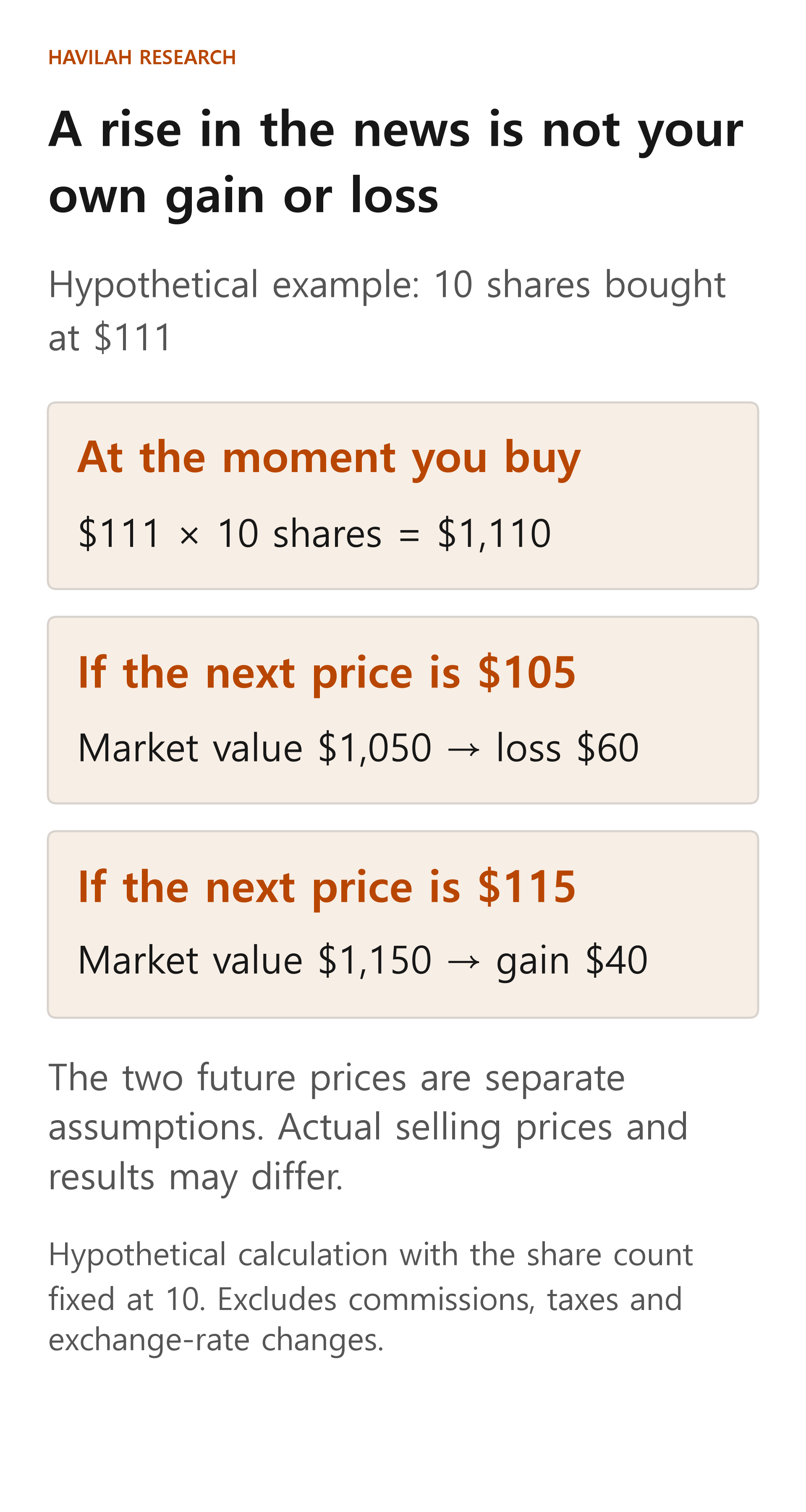
Notice that even in the first situation, the share price is still higher than the previous close of $100. The news may still say "up from the previous close," but your account, which bought at $111, shows a loss. That is because the news compares against a different reference point from your purchase price.
This market value has not become cash in your account. If you actually sell, your realized gain or loss can differ depending on the fill price and costs. Nor does buying in extended hours by itself mean that you will lose money. The lesson of this example is not to mistake the percentage gain on the screen for your own expected return.
5. A limit order sets your price, but it does not prevent losses
A limit order sets the highest price you will pay when buying, or the lowest price you will accept when selling. Some services accept only limit orders outside the regular session, so check first which order types are supported.
In the example above, if you had set a buy limit of $110, your order would not be filled at $111. Instead, if no one sells within that limit, no trade may take place.
Even if your order fills at the price you wanted, the risk that the share price falls afterward remains. A limit order is a tool for controlling your order price, not a device that prevents losses after you buy.
It also matters what happens to any remaining order when a trading session ends. Check your broker's order conditions to see whether it is canceled when that session ends or carries over into the next session. Do not assume that an order you placed during the regular session automatically stays live in extended hours.
Even if you see a better quote on another screen, your order will not necessarily fill at that price. Outside the regular session, the connections between trading systems and the price information available can differ. That is why you need to check which hours and stocks your broker supports.
6. "Can I trade now?" versus "Do I have a reason to trade now?"
If you are thinking about extended-hours trading, first check which session's prices the current screen is showing. Do not look only at the last price; check the current bid and ask, their quantities and the time shown as well.
Next, read your broker's guide for the stocks you can trade, the order types, how long orders stay active and how remaining orders are handled. If the broker supports separate overnight trading, check whether the same conditions apply there too. A service you use during your daytime may be running in the middle of the night in the United States, so be clear about which time zone a timetable uses.
Finally, think about why you want to place an order now. You should be able to explain whether you have fully understood the new information, and whether there is a price you are prepared to accept even when the gap between the quotes is wide. If you feel rushed and find it hard to put your reasons in order, you can choose not to hurry and to read more information instead.
Waiting does not guarantee you a better price in the next regular session. Whether you trade now or wait, each choice has a cost. The key is to decide by looking at what you know together with the actual trading conditions.
In the next lesson, we will look at situations such as stock splits and trading halts, in which the number of shares in your account, or whether you can trade at all, changes regardless of the trading session.